If you are a gardener in Florida, you have probably heard that you can’t grow garlic due to the state’s hot, humid weather. While it’s true that garlic thrives in cooler climates, it’s entirely possible to grow it successfully in Florida with the right approach. The heat and humidity can pose challenges, but by choosing the right varieties and planting at the right time, you can enjoy a productive garlic harvest. In this guide, we’ll break down why some people believe garlic isn’t suited for Florida’s climate and what you can do to grow it effectively in your own garden.

Planting Season
Timing is everything when it comes to gardening, especially in Florida’s unique climate. With six months of intense heat followed by a relatively mild “winter,” planning becomes crucial for crops that need cooler temperatures or specific daylight conditions to thrive. Florida winters rarely drop below 40°F, leading some to claim we don’t have a “real” winter at all. This makes it essential to carefully plan your garden, particularly for long-season crops like garlic, which require a certain amount of cooler weather to properly bulb and grow.
Garlic requires a minimum of 40 nights of 40F and under in order to properly develop a bulb. The biggest part of the Sunshine State rarely meets that quota. To mimic this process, growers in Florida will need to either vernalize their garlic or purchase pre-vernalized garlic. The way we artificially simulate that process is by placing the cloves in the fridge for about 4-6 weeks in a ventilated bag (to prevent mold) prior to planting and then planting them during Florida’s cooler months, October- November. After vernalization, as the temperature rises and daylight increases, the garlic begins its active growth phase, developing larger, more robust bulbs.
Can I plant non-vernalized garlic in Florida?
The short answer is yes. The long answer is you shouldn’t. The vernalization process ensures the growth of the bulb and division of the gloves. Without it, growers will harvest underdeveloped garlic heads.

Garlic Varieties Suited for Florida:
When it comes to growing garlic in Florida, selecting the right variety is crucial. Florida’s warm climate presents unique challenges, especially for crops that traditionally thrive in cooler conditions. The two main types of garlic—softneck and hardneck—have different requirements and growth habits, which makes softneck varieties generally more suitable for Florida gardens. From my personal experience and from what I heard from other local growers, inchelium red seems to be the best variety to grow in Florida. Inchelium red is a soft-neck variety.
Softneck garlic, as the name suggests, has a flexible stem, making it ideal for braiding. It tends to have more cloves, arranged in multiple layers, and is well-suited to warmer climates like Florida, as it doesn’t require a long, cold period to develop properly. This type of garlic is known for its mild flavor and long shelf life, making it a popular choice for both gardeners and supermarkets. Hardneck garlic, on the other hand, has a rigid central stalk and fewer, larger cloves arranged in a single circle around the stalk. It produces edible scapes and offers a stronger, more complex flavor, but it’s less suited to warm climates and has a shorter shelf life.

Soil Preparation and Water Requirement
Understanding Florida’s weather patterns and soil structure is essential for successful gardening. Let’s start with the climate. Florida’s hot summers often bring daily afternoon rain, providing ample moisture for plants. However, as fall approaches, rainfall typically decreases—except during El Niño years, when winters tend to be wetter than usual. While cooler months require less water for plants, it’s still crucial to maintain consistent watering to ensure healthy growth throughout the season.
Generally speaking, Florida soil tends to be sandy. Sand does not hold nutrients or water well. This means that our soil tends to be less than ideal for most vegetables – especially those that are considered heavy feeders. The soil quality can be improved in a few different ways. I personally like to top our beds with quality compost every 4-6 months and create a fertilizer schedule, among a few other things. I use organic all-purpose vegetable fertilizer to feed my soil every few months. Another strategy that we have recently implemented is incorporating clay into our beds. Incorporating clay into Florida’s sandy soil improves its ability to hold water and nutrients by enhancing its structure. Sandy soil, which drains quickly, often struggles to retain moisture and essential nutrients that plants need to thrive. Clay particles, being smaller and more compact, create a denser soil mix that slows down water drainage and helps trap nutrients, making them more accessible to plants over time.

Fertilization:
Just before planting, mix a couple of tablespoons of 5-10-10 complete organic fertilizer, bonemeal, or fish meal into the soil a few inches below where the base of the garlic cloves will be placed. Choose large, healthy cloves that are free from disease, as larger cloves generally result in bigger and healthier bulbs when harvested.
It’s best to keep the bulbs intact until one or two days before planting. Ideally, crack them open on the day of planting. Once separated from the root plate, cloves start to degrade, so avoid early separation. Keep the husks on the cloves—they don’t need to be removed, as this doesn’t significantly impact growth.
Plant the cloves 4 to 8 inches apart and 2 inches deep, ensuring they are positioned upright, with the wider root side down and the pointed end facing up. Space the rows 6 to 12 inches apart.

Planting Elephant Garlic in Florida
Many people like to use this garlic alternative due to its size, ease of growth, and heat tolerance. Elephant Garlic isnt a true garlic, but it produces a very similar flavor compound when crushed.
Pest/Disease management
Although in personal experience, I haven’t encountered many pest/disease issues with garlic, other growers can encounter some challenges just like any other crop. Thrips are a common issue, as they suck the sap from garlic leaves, causing streaks and weakening the plants. Onion maggots can burrow into the bulbs, leading to decay and poor growth, while nematodes can damage the roots, stunting the plants. Aphids are another concern, as they not only feed on plants but can also transmit diseases. Cutworms can cut off young garlic plants at the base, particularly in the early growth stages.
In terms of diseases, white rot is a significant problem in Florida, causing yellowing leaves and bulb rot, especially in cool, moist conditions. Botrytis rot, or gray mold, thrives in humid environments and can lead to soft, mushy spots on the bulbs. Downy mildew, another fungal disease, can cause moldy patches on the leaves, stunting plant growth. Fusarium basal rot affects the base of the bulbs, leading to premature plant death and poor bulb development. Controlling moisture levels and monitoring for these pests and diseases is key to growing healthy garlic in Florida.
To mitigate a lot of these issues, it is important to space your plants accordingly, practice crop rotation, create a diverse garden in order to attract beneficial, fertilize your seed at the appropriate time at the appropriate rate, and practice integrated pest management. I recommend crab meal in order to reduce root-knot nematode ( microscopic, soil-borne worms that infect plant roots, causing galls or knots that disrupt water and nutrient uptake, leading to stunted growth and weakened plants) issues. For most bulbs and tubers, it is advised not to overwater (especially in the first few weeks after planting) as it can lead to rot.
Harvesting Garlic:

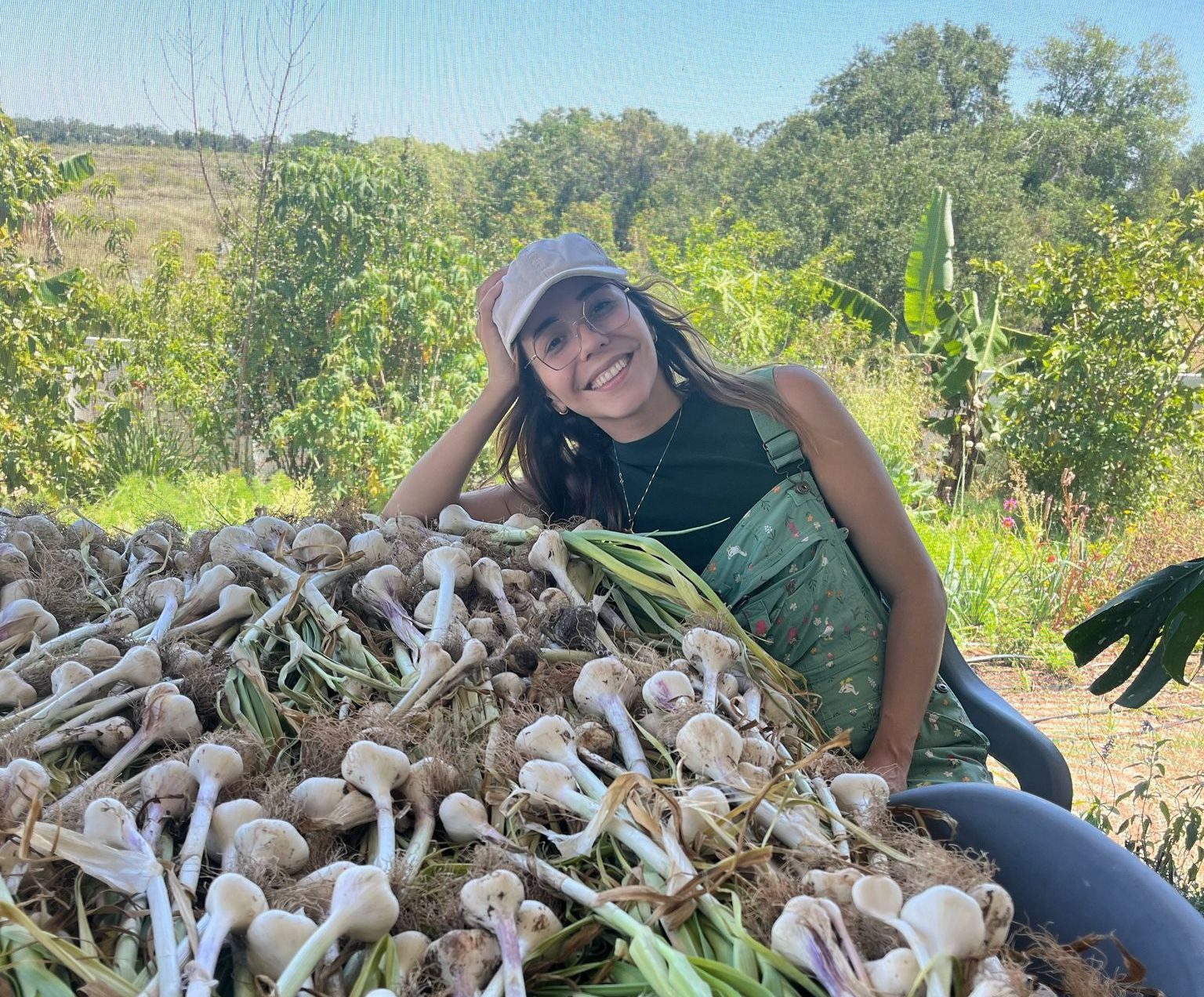
The harvest time will be around April-May. To determine if it’s time to harvest, notice if about ⅓ of the leaves are brown/died back. Gently thug your plants by the neck closer to the base.
After harvesting, let garlic cure in a dry, shady spot with good air circulation for about two weeks. I like to place our garlic on a wire shelf on our lanai. Many folks like to braid the garlic and hang it on storage. You can hang the garlic in bunches of 4 to 6 or place it on a homemade rack made from chicken wire. Once the wrappers are dry and papery, the roots are dry, and the cloves can be easily separated, the garlic is ready for storage.
To store, gently brush off dirt, trim roots to about ¼ inch, and cut tops down to 1-2 inches. Store the bulbs in a cool, dark, dry place—avoid humid areas like basements (most houses in Florida don’t have that haha) or the refrigerator. Properly stored garlic will last for several months, with its flavor improving as it dries.