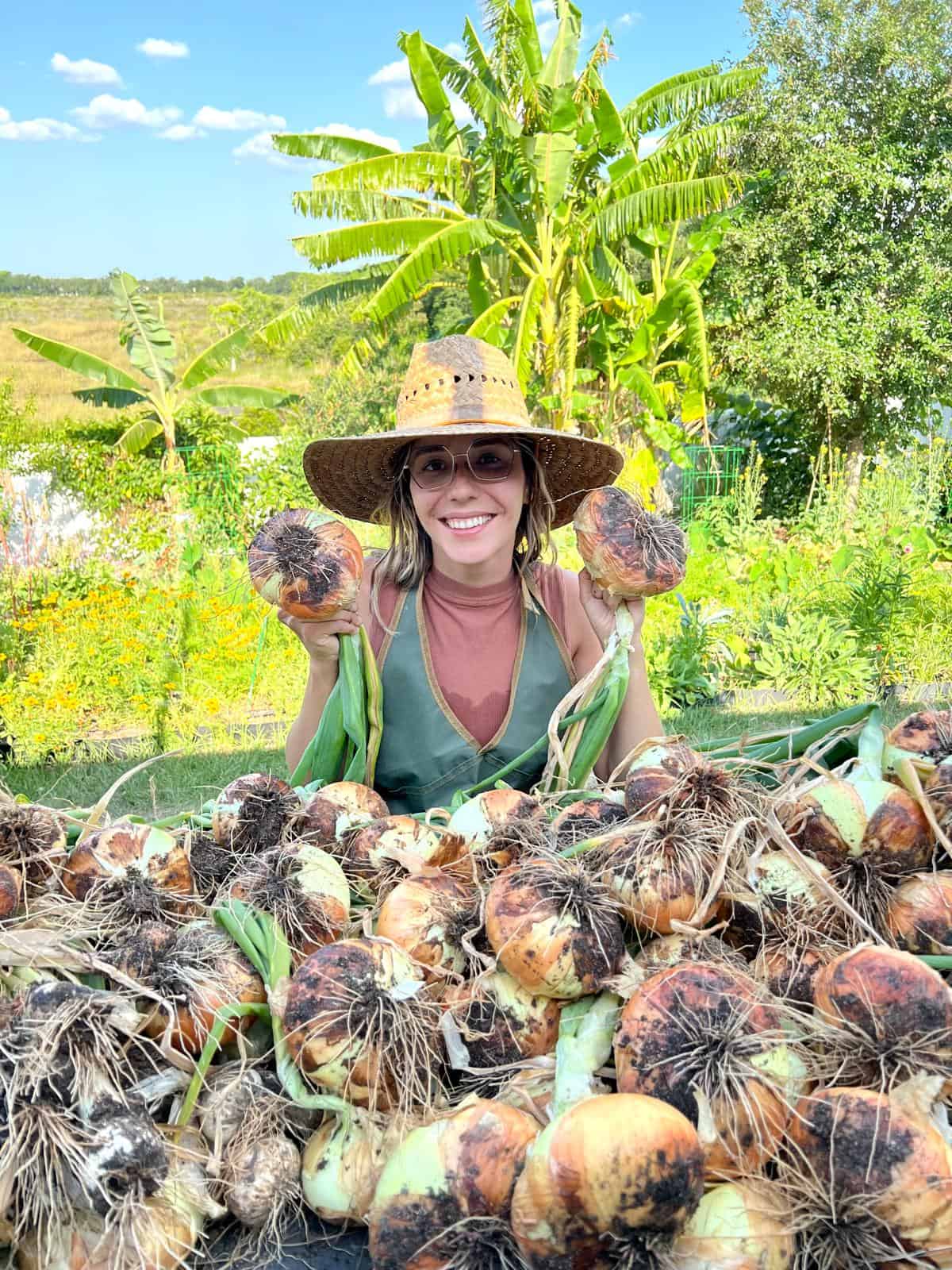
While carrots may be my favorite crop to grow, onions and garlic are by far the most practical. Every time I share a harvest video showing off my 100+ onions and garlic, the most common question I get is, “Why do you grow so much?” The answer is simple: by taking advantage of their short planting windows, I can grow enough to last the entire year. In this blog post, I’ll be sharing my journey and tips for growing onions right here in the Sunshine State.
Onion Varieties for Florida


One of the biggest factors to take into consideration to determine what varieties to grow in Florida is to understand our climate and daylight length during the cooler months. Onions can be classified into three types based on how much sunlight they need to properly bulb up: short-day, intermediate-day, and long-day onions.

- Short-day onions require about 10-12 hours of daylight to begin bulb formation. They are typically planted in mid-early winter. Short-day onions tend to be sweeter (but this can vary depending on the variety). My favorite varieties to grow in Florida are Texas early white, vidora, and red creole.
- Intermediate-day onions: require 12-14 hours of daylight to begin bulb formation. This type is usually better suited for the middle part of the United States.
- Long-day onions: require 14-16 hours of daylight to begin bulb formation. They are normally grown in areas with long summer days. They are normally grown in the northern regions of the United States during summer.
We have experience with a few varieties so far, and walla-walla seems to be the best performer in terms of size. However, the other varieties we grew did well as well. The other varieties we have tried are Vidora, red creole, and Texas Early White. Red creole is a smaller, pungent red variety that can be stored for up to 6-7 months if stored properly.

Onion Alternatives to Grow in Florida


The Florida Finley Onion is a resilient heirloom variety with a 50-year history in Polk County, Central Florida. It’s well-suited to the Florida climate, making it an easy-to-grow choice for home gardeners. This variety is planted directly from bulbs in the fall, grows vigorously, and multiplies throughout the season. With a garlicky flavor and versatile culinary uses—from its sweet green leaves to its flavorful bulbs—it’s a valuable addition to any Florida garden. The ability to store and replant the bulbs year after year makes it a sustainable crop, preserving a piece of local history while promoting a more localized food system. I have been growing these for three years now and will continue to grow them in the future, but I would not consider them a substitute for commercial onion varieties due to their size. If you are interested in purchasing some, they are usually sold between September and October.
Best Time to Plant Onions in Florida

Onions are normally grown during the cooler months here in the state of Florida, which means that short-day onions are the most suitable kind for us. Planting time will vary slightly between South Florida and North Florida, but generally speaking, September-December is the ideal range to start them. You can choose to start them from seed or buy the sets online on sites such as Dixxondale or Hoss Tools.
For Central and South Florida, the ideal planting time is from October to December. (It’s important to note that the planting date will vary greatly depending on how you choose to start your onions. Seeds can be started in September, and bulbs/sets are usually transplanted in November). This gives the bulbs enough time to establish roots and begin bulbing when the days are still relatively short. The cooler temperatures of fall and early winter give the onions a chance to grow without the stress of extreme heat, which can lead to poor bulb development or premature bolting (flowering too early). Planting in the fall also allows the onions to take advantage of the short-day conditions that they require for proper growth.
In North Florida, planting can start a little earlier, around late September to November, because temperatures in this region drop sooner, allowing for more flexibility. Gardeners in this area should also ensure that they are planting during a time when the cooler weather is consistent, as onions need a cold period to help with bulb formation.
By the time spring arrives, the onions will have matured enough to handle the transition into slightly warmer temperatures without being exposed to the harsh heat of summer. Harvest typically occurs in late spring before the intense summer heat sets in, which can stress the plants and negatively affect bulb size and quality.
Soil Preparation

One of the statements I make the most is how sandy Florida soil tends to be, which has both benefits and challenges. Sandy soil provides good drainage, which is important for onions because they do not tolerate waterlogged conditions. However, sandy soils can be low in organic matter and nutrients, making it difficult for plants to grow and thrive.
One of the ways I improve my soil quality is by amending the soil with organic matter. Organic materials such as compost, well-rotted manure, or leaf mold should be incorporated into the soil before planting. I like to incorporate about 2-3 inches of organic matter and slightly mixing into the soil, which can significantly improve the soil’s structure, water retention, and nutrient content. This also helps improve the soil structure.
Planting Methods
Fall and winter are our busiest months of the year in the garden. We are often starting hundreds of seedlings every few weeks. We start veggies, flowers, herbs, and everything else that requires cooler temperatures to grow. Since our space to start seedlings is limited, we prefer to order sets online instead of starting them with seeds. But many prefer to plant bulbs or start from seed. I haven’t personally experienced bulbs; however, a few friends have, and in their personal experience, bulbs tend not to perform well and many times bolt.

Planting Onion Sets Onion sets are small, pre-grown bulbs from the previous season that have been put into dormancy (they look like baby onions). Since they’ve already started their growth cycle, they can lead to inconsistent harvests. The stress of being partially grown makes them more sensitive to changes in temperature, which can cause early bolting or irregular growth.
- How to Plant: Place the sets in the soil with the pointed end facing upward. Ensure the bulb is just deep enough to cover the base and keep the top part of the bulb slightly exposed. Press them into the soil gently, and then cover lightly with soil.

Planting Onion Seeds Planting onions from seeds gives you access to a wider variety of onion types, including heirloom varieties. However, growing from seed requires more time and patience. In Florida, seeds are usually started indoors 6-8 weeks before the ideal planting time and then transplanted into the garden.
- How to Plant: Sow seeds about ¼ inch deep in seed trays or directly into well-prepared garden soil. If starting seeds indoors, keep them in a warm area with plenty of light until they’re ready to be transplanted.
Planting Onion Transplants Onion transplants are young seedlings that are ready to be moved into the garden (they look like green onions). These are grown in the same season as they are harvested and are pulled right before they are shipped. This is my favorite option, and it’s how I have been growing onions for the past 5 years.

- How to Plant: When planting transplants, place the roots and about one inch of the base into the soil, leaving the green tops exposed. Water them immediately after planting to help establish root growth.
Irrigation and Watering Tips

Consistent irrigation is key to growing healthy vegetables in Florida. If you have read any of my other blog posts you are probably tired of reading how many times I state that drip irrigation system is my favorite irrigation system and how effective it is! For good measure, I will state this again! Our irrigation system was probably my favorite garden investment as it reduced my time watering and it delivers 90% of the water it takes.
The drip tape emitters can be spaced 4-24 inches apart and are highly customizable. I recommend picking emitters that are spaced 4-6 inches apart, as Florida sandy soil seems to benefit from the extra watering. If you would like to learn more about the drip irrigation system, click here.
Fertilization

In addition to organic matter, I also like to mend the soil with a well-balanced, slow-release organic fertilizer (click here to buy). They need a good supply of nitrogen, phosphorus, and potassium, along with micronutrients like sulfur and magnesium, for optimal growth. In the second and third months after transplanting, we like to supply extra nitrogen by using fish emulsion, encouraging green growth.
Common Pests and Diseases in Florida

From my personal experience, growing onions in Florida are simple if the set up, timing, and variety are right. However, pests and diseases can still strike. Let’s talk about some of the issues you might encounter !
Thrips are tiny, winged insects that suck the sap from onion leaves, causing silvery streaks, curling, and withering of the leaves (they look like very tiny ants for the untrained eye and can be easily seen on flowers and berries). Thrips thrive in warm, dry conditions, making them a common issue for Florida onion growers, particularly in dry weather. Use insecticidal soaps or neem oil to control thrips.
Onion Maggots Onion maggots are the larvae of a fly that lays eggs at the base of onion plants. The larvae burrow into the bulbs, causing soft spots and rot, which can lead to plant death. These pests are more of a problem in cool, wet conditions, but they can still be an issue in Florida during certain parts of the growing season. Management includes crop rotation, removal, and disposal of infected plants, and row covers can be used to prevent flies from laying eggs.
Other Common Pests
- Cutworms: These pests can chew through onion seedlings at the base. You can prevent them by using collars around young plants or spreading diatomaceous earth around the base of the plants. Cutworms are the ban of my garden existence and probably my number 1 enemy. I have lost countless seedlings to them. For onions, it might not be a big deal to lose a few plants, but for crops such as tomatoes, peppers, and squash, it might mean losing that crop for that growing season.
- Aphids: Aphids can be controlled with insecticidal soap or by encouraging beneficial insects like ladybugs.
Harvesting and Storage

Determining the right time to harvest onions is quite simple! Whenever the tops start to fall over, the plant is done growing. I personally like to harvest the onions and place them to dry in a wire hack on my lanai for about 2-3 weeks before bringing them inside. However, in many growing operations, the onions are left in the field for drying before being stored.
I recommend storing the onions in a dry, dark spot. Depending on the variety, the onions can be kept on storage for up to 5-6 months; however, sweeter varieties tend to last 2-3 months. As we tend to harvest enough onions for the year, I like to process most of it by freezing and dehydrating most of it.
Conclusion
Growing onions in Florida is simpler than it seems when you know what to expect. By understanding the climate, choosing the right short-day varieties, and planting at the right time, you can have a steady supply of onions that lasts all year. Whether you’re looking for a sweeter onion, one with long storage potential, or a hardy heirloom like the Florida Finley, there’s a variety that fits your needs. With proper soil preparation, consistent care, and a few pest-control tips, you’ll be ready to harvest your own fresh onions. Happy gardening!